VITAL II: Vertical profiling of the troposphere: Innovation, opTimization and AppLication II
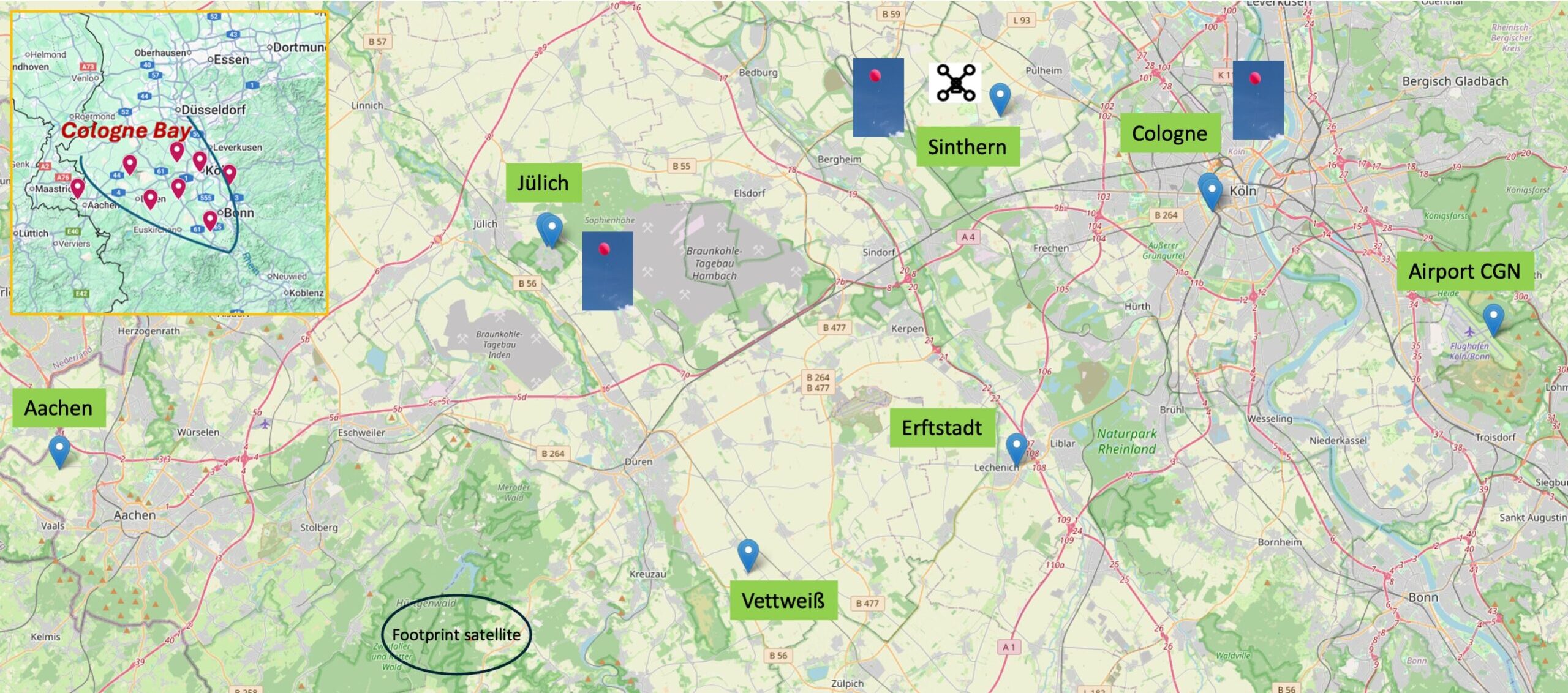
Fig. 1: VITAL II observational setup concentrated in the Cologne Bay (see inset figure, upper left). Blue markers indicate the seven VITAL II profiling sites for wind, turbulence, temperature and humidity with ground-based remote sensing technology. ~120 Radiosondes can be launched on demand at the sites indicating a red balloon. UAS multicopter profiling will take place in Sinthern during an Intensive Observation Period in the first two weeks of August 2026. The grey oval indicates an MTG-S1 footprint – the area for temperature and humidity profiling from the Infrared Sounder on-board MTG-S1. IRS coverage is available over the whole domain. Source of the map: Google Maps and Open Street Maps.
In VITAL II, the types of ground-based profilers tested in VITAL I were set-up and distributed in a model region (Fig. 1). VITAL II took place from June 1 – September 25, 2026 in the Cologne Bay region between the west German cities of Cologne, Bonn and Aachen. Eight atmospheric profiling sites were installed, equipped with wind profilers (Doppler lidars), water vapor profilers (water vapor lidars and the GRAWAC water vapor radar) and temperature profilers (microwave radiometers) (Fig. 2). As far as applicable, these instruments were operated and measurements processed according to ACTRIS/Cloudnet standards. In addition, a dense surface meteorology network with over 50 measurement stations (Fig. 3), so-called APOLLOs, was installed. Note, operationally DWD only operates a handful of weather stations in Cologne Bay. Between August 3 and 14 automated and manual multi-copter UAS launches were carried out at the Sinthern profiling site for profiling of temperature, humidity, wind and turbulence every 30 minutes up to a height of ~2 km.
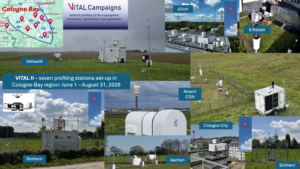
Fig. 2: Collage of the profiling instruments set-up at the seven profiling sites (see Fig. 1). Visualizations of VITAL II data is provided through the VITAL II quicklook-browser. Image credits: R. Haseneder-Lind, P. Pospichal, U. Löhnert
In parallel, first data from the Meteosat Third Generation Sounder (MTG-S1) satellite Infrared Sounder (IRS) instrument became available from Aug. 1 providing unprecedented continuous three-dimensional observations of temperature and humidity over large parts of Europe and Africa with a temporal resolution of ~30 min. Up to now such observations were only available four times daily. However, satellite deficits remain in observing the ABL, e.g. through strong influence of the surface. VITAL II leverages the use of these novel satellite sounder observations, in addition to further satellite observations (e.g. MTG-I FCI) by combining them with ground-based in-situ and remote sensing observations. Novel machine learning algorithms synthesize IRS data with surface-based observations and are currently being applied and developed at the University Cologne and will be assessed by the multitude of additional VITAL II profiling observations. These encompass up to ~115 additional radiosondes that were launched in the Cologne Bay region by PhD and master students of the Universities of Cologne and Bonn. VITAL II will provide answers to the question: how much can we improve ABL profiling through combining ground-based observations with modern satellite observations?
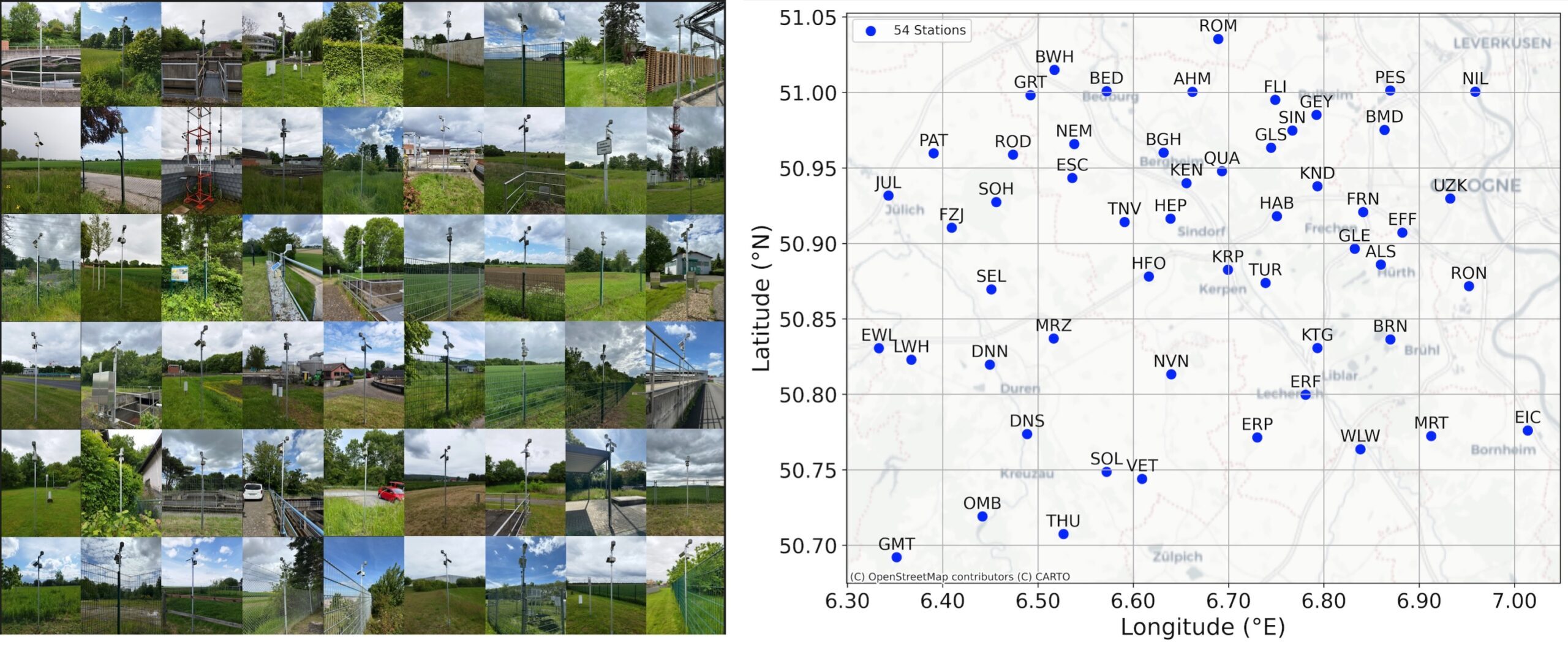
Fig. 3: Collage of the 54 set-up APOLLO weather stations (near surface measurements of temperature, humidity and pressure) (left) und their distribution in Cologne Bay (right). Image credits: A. Rapmund
With the unique VITAL II data set, HErZ scientists from the University of Cologne will be able to investigate regional differences in the lowest kilometers of the atmosphere, thus understand more about the local wind systems and weather phenomena in Cologne Bay. The data will be used by scientists from the Universities of Munich (LMU) and Frankfurt to evaluate and adapt turbulence schemes in DWD’s state-of-the-art numerical weather prediction model ICON-D2. Turbulent schemes need be to improved because they are essential, e.g. for modeling the evolution of clouds and thus severe thunderstorms and precipitation. Severe thunderstorms in Cologne Bay during the summer of 2026 are a current VITAL focus at the University of Hamburg. The APOLLO network, combined with the profiling stations, will give scientists a three-dimensional impression of convective cold pools, i.e. cold air flows, often preceding summer-time thunderstorms associated with strong wind gusts. Here the question is: what is the relationship between wind, temperature and humidity and how are cold pools influencing the generation of new thunderstorms? In future, VITAL II data will also be assimilated into the ICON model. This means, these data will be used to initialize weather forecasts, in addition to the data commonly used by DWD. Here the question is: how much impact do these observations have for improving the Cologne Bay weather? And in future: how do AI-based weather prediction models react to the additional observations compared to the “classical” models?
VITAL II extends upon the success of the FESSTVaL, a 2021 field experiment which focused on the meso-gamma-scale (2-20km) providing a high-density surface observation network paired with continuous, ground-based atmospheric profiling at three distinct locations within 6 km of each other. As for FESSTVaL, VITAL II data will be made publicly accessible after the campaign, when processing and data quality controls has been carried out. Stay tuned!
Visualization of VITAL II data is provided through the VITAL II quicklook-browser.
The VITAL II concept paper drafted in the early planning stage can be found here: 10.5281/zenodo.17424651
For further information please contact us:
| Campaign organization, profiling stations & data access | Ulrich Löhnert (University of Cologne) |
| APOLLO network | Anja Rapmund & Felix Ament (University of Hamburg) |
| Radiosonde launches | Bernhard Pospichal (University of Cologne) |
| UAS (drone) profiling | Yann Büchau & Andreas Platis (University of Tübingen) |
| Numerical modeling concept | Mirjana Sakradzija (LMU Munich) |
VITAL II partners and collaborators: