VITAL: Vertical profiling of the troposphere: Innovation, opTimization and AppLication
The VITAL (Vertical profiling of the troposphere: Innovation, opTimization and AppLication) concept targets the highly important observations of the vertical structure of the lower part of the atmosphere, the so-called atmospheric boundary layer (ABL). Here, almost all human life takes place. Why are these observations vital? They are essential for enhancing our understanding of atmospheric processes and improving short-term weather prediction. Especially information on the vertical distribution of temperature, water vapor and wind speed and direction are essential. However, there are far too few of such observations, e.g. radiosonde ascents (classical weather balloon soundings) are only performed once or twice a day and only at a small number of distinct locations. So, how to obtain more observations — in space and in time? And once we have these observations: can they improve our weather forecasts? These are important questions that VITAL addresses within the Hans Ertel Centre for Weather Research (HErZ), a research cooperation between German universities and the German Meteorological Service (DWD — Deutscher Wetterdienst). Four HErZ projects, DWD observational and modeling experts as well as external partners are contributing to VITAL. VITAL is a two-part concept consisting of VITAL I and VITAL II.
VITAL I took place in August 2024 at the Jülich Observatory for Cloud Evolution (JOYCE), which is a National Facility of the ACTRIS European Research Infrastructure Consortium. Novel types of ABL profilers, that are being considered for the next-generation DWD observational network were thoroughly tested and evaluated. Vertical profiling data sets using multi-copter Uncrewed Aerial Systems (UAS), i.e drones, and the ground-based remote sensing profilers Doppler lidar, water vapor lidar and microwave radiometer were created and evaluated against radiosondes and data from a 120m meteorological tower. VITAL I also participated in the core phase of the 2024 world-wide WMO UAS Demonstration campaign with two small UAS applying a novel, improved wind and turbulence estimation technique. During VITAL I, an international summer school was held at JOYCE to educate students from the Bachelor to PhD level in Modern Methods in Atmospheric Profiling.
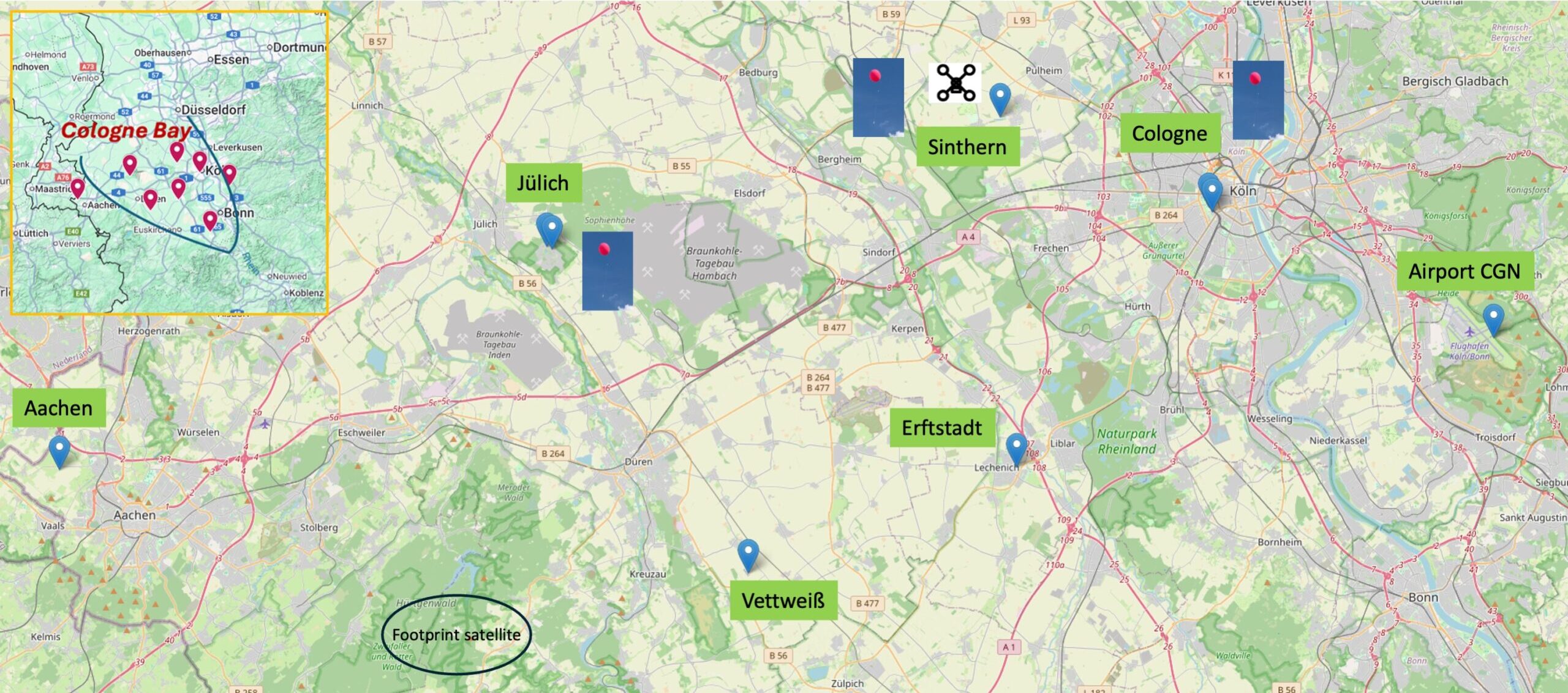
Fig. 1: VITAL II observational setup concentrated in the Cologne Bay (see inset figure, upper left). Blue markers indicate the seven VITAL II profiling sites for wind, turbulence, temperature and humidity with ground-based remote sensing technology. ~120 Radiosondes can be launched on demand at the sites indicating a red balloon. UAS multicopter profiling will take place in Sinthern during an Intensive Observation Period in the first two weeks of August 2026. The grey oval indicates an MTG-S1 footprint — the area for temperature and humidity profiling from the Infrared Sounder on-board MTG-S1. IRS coverage is available over the whole domain. Source of the map: Google Maps and Open Street Maps.
In VITAL II, the types of ground-based profilers tested in VITAL I are set-up and distributed in a model region (Fig. 1). VITAL II is taking place from June 1 – August 31, 2026 in the Cologne Bay region between the west German cities of Cologne, Bonn and Aachen. Seven atmospheric profiling sites have been installed, equipped with wind profilers (Doppler lidars), water vapor profilers (water vapor lidars and the GRAWAC water vapor radar) and temperature profilers (microwave radiometers) (Fig. 2). As far as applicable, these instruments are operated and measurements are processed according to ACTRIS/Cloudnet standards. In addition, a dense surface meteorology network with over 50 measurement stations (Fig. 3), so-called APOLLOs, has been installed. Note, operationally DWD only operates a handful of weather stations in Cologne Bay. During the first two weeks in August, an automated multi-copter UAS launcher will be installed at the Sinthern profiling site for profiling of temperature, humidity, wind and even turbulence every 30 minutes up to a possible height of ~2 km.
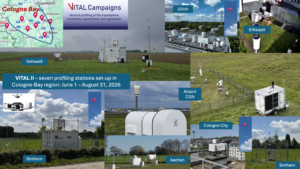
Fig. 2: Collage of the profiling instruments set-up at the seven profiling sites (see Fig. 1). Image credits: R. Haseneder-Lind, P. Pospichal, U. Löhnert
In parallel, first data from the Meteosat Third Generation Sounder (MTG-S1) satellite Infrared Sounder (IRS) instrument is becoming available providing unprecedented continuous three-dimensional observations of temperature and humidity over large parts of Europe and Africa with a temporal resolution of ~30 min. Up to now such observations were only available four times daily. However, satellite deficits remain in observing the ABL, e.g. through strong influence of the surface. VITAL II will leverage the use of these novel satellite sounder observations, in addition to further satellite observations (e.g. MTG‑I FCI) by combining them with ground-based in-situ and remote sensing observations. Novel machine learning algorithms which will synthesize IRS data with surface-based observations are currently developed at the University Cologne and will be applied to and assessed by the multitude of additional VITAL II profiling observations. These will encompass up to ~120 additional radiosondes, that will be launched in the Cologne Bay region in summer months of 2026 by PhD and master students of the Universities of Cologne and Bonn. VITAL II will provide answers to the question: how much can we improve ABL profiling through combining ground-based observations with modern satellite observations?
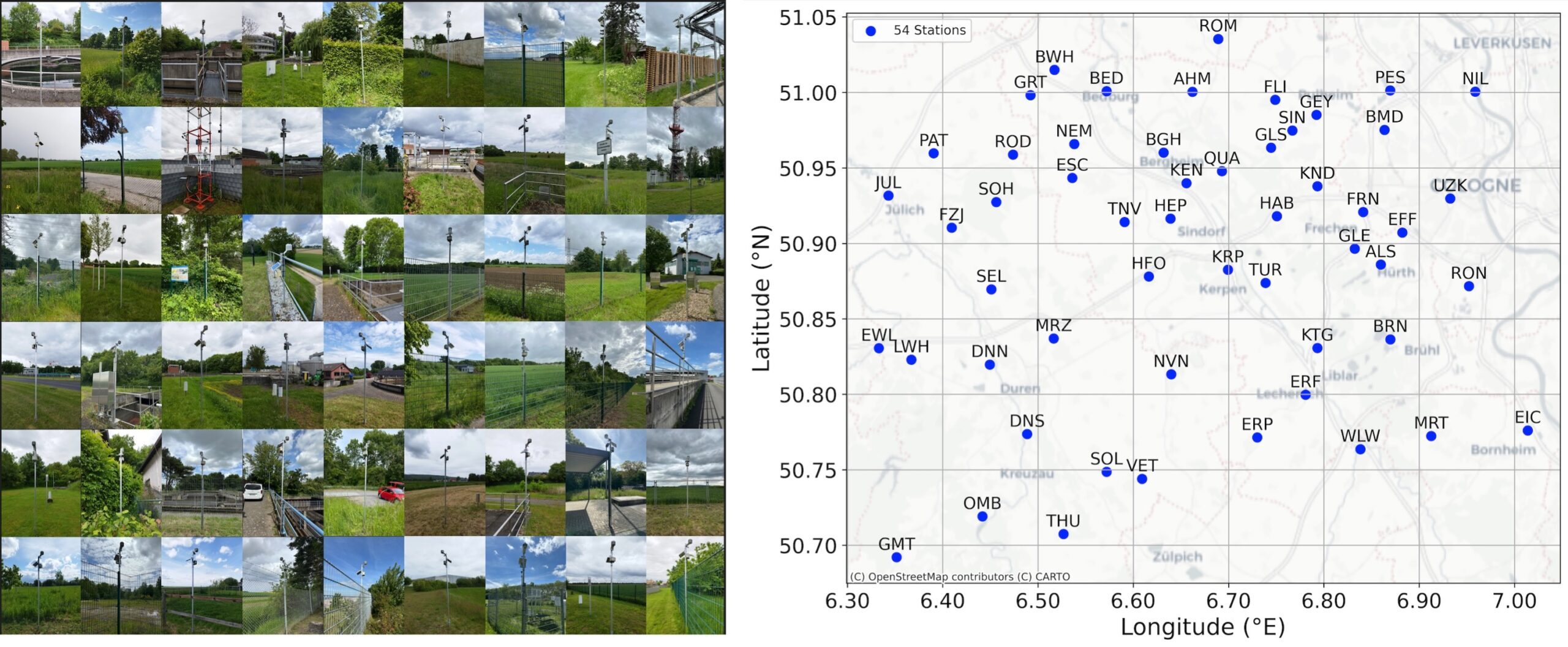
Fig. 3: Collage of the 54 set-up APOLLO weather stations (near surface measurements of temperature, humidity and pressure) (left) und their distribution in Cologne Bay (right). Image credits: A. Rapmund
With the unique VITAL II data set, HErZ scientists from the University of Cologne will be able to investigate regional differences in the lowest kilometers of the atmosphere, thus understand more about the local wind systems and weather phenomena in Cologne Bay. The data will be used by scientists from the Universities of Munich (LMU) and Frankfurt to evaluate and adapt turbulence schemes in DWD’s state-of-the-art numerical weather prediction model ICON-D2. Turbulent schemes need be to improved because they are essential, e.g. for modeling the evolution of clouds and thus severe thunderstorms and precipitation. Severe thunderstorms in Cologne Bay during the summer of 2026 are a current VITAL focus at the University of Hamburg. The APOLLO network, combined with the profiling stations, will give scientists a three-dimensional impression of convective cold pools, i.e. cold air flows, often preceding summer-time thunderstorms associated with strong wind gusts. Here the question is: what is the relationship between wind, temperature and humidity and how are cold pools influencing the generation of new thunderstorms? In future, VITAL II data will also be assimilated into the ICON model. This means, these data will be used to initialize weather forecasts, in addition to the data commonly used by DWD. Here the question is: how much impact do these observations have for improving the Cologne Bay weather? And in future: how do AI-based weather prediction models react to the additional observations compared to the “classical” models?
VITAL II extends upon the success of the FESSTVaL, a 2021 field experiment which focused on the meso-gamma-scale (2–20km) providing a high-density surface observation network paired with continuous, ground-based atmospheric profiling at three distinct locations within 6 km of each other. As for FESSTVaL, VITAL II data will be made publicly accessible after the campaign, when processing and data quality controls has been carried out. Stay tuned!
We are working on visualizing our data after measurements have been taken. For data visualization, access our VITAL II quicklook-browser. For an overview of the APOLLO measurements, please access the APOLLO page.
The VITAL II concept paper drafted in the early planning stage can be found here: 10.5281/zenodo.17424651
For further information please contact us:
| Campaign organization, profiling stations & data access | Ulrich Löhnert (University of Cologne) |
| APOLLO network | Anja Rapmund & Felix Ament (University of Hamburg) |
| Radiosonde launches | Bernhard Pospichal (University of Cologne) |
| UAS (drone) profiling | Yann Büchau & Andreas Platis (University of Tübingen) |
| Numerical modeling concept | Mirjana Sakradzija (LMU Munich) |
VITAL II partners and collaborators: